

You come in for your adjustment. Your back feels great, your neck moves freely, and you walk out lighter. But there’s one spot, maybe a heel, a knee or a shoulder, that never quite lets go. It gets better for a while, then it’s right back.
If that’s you, there’s a good reason, and a good fix. Since 2001, Harbor Family Chiropractic has helped Costa Mesa families feel and move better. Today, Dr. Stacey Gillis pairs chiropractic care with SoftWave therapy to reach the stubborn problems that adjustments alone can’t fully resolve.
Why some pain hits a plateau
Chiropractic care is excellent at restoring how your joints move and how your body carries load. When your spine, hips and feet are working together, everyday strain on your tissues drops.
But some injuries live in the soft tissue itself: the tendon that’s been irritated for a year, the fascia on the bottom of your foot, the rotator cuff that never fully recovered after a tough season. Once that tissue has been inflamed long enough, the body can stop actively repairing it. Better mechanics take pressure off, but the damaged tissue may still need a push to start healing again.
That’s the gap SoftWave fills.
What each therapy does best
Chiropractic care: the mechanics
- Restores joint motion and alignment
- Reduces abnormal stress on muscles, tendons and ligaments
- Supports healthy nervous system function and posture
- Helps prevent the overload that caused the injury in the first place
SoftWave therapy: the tissue
- Sends broad, gentle pulse waves deep into injured tissue
- FDA-cleared to temporarily increase local blood circulation, relieve minor aches and pains, and activate connective tissue
- Takes about 5 to 10 minutes, with no needles, medication or downtime
- Most conditions respond in 3 to 6 sessions
One fixes the “why does this keep happening” problem. The other helps the injured area actually heal. Add therapeutic massage from our team, Nicole and Monica, to release tight, guarded muscle, and you’re addressing pain from every direction. For a deeper look at the SoftWave side, read why a full SoftWave therapy plan is what makes relief last on our SoftWave Therapy Orange County blog.
Current patients: ask about SoftWave at your next adjustment
You’re already doing the hard part by showing up for your care. If one area keeps flaring up, Dr. Gillis can assess it during your next visit and tell you whether SoftWave would help. There’s no need to start over as a new patient.
Signs you’re a good candidate for chiropractic + SoftWave
The combination tends to be a strong fit if any of these sound familiar:
- A specific area keeps hurting even though your adjustments help overall
- Heel pain that’s worst with your first steps in the morning (often plantar fasciitis)
- Knee or shoulder pain that limits workouts, sleep or daily tasks
- A sports injury that’s lingered for months
- You’ve tried cortisone shots and the relief didn’t last
- You’d like to explore non-surgical options before considering surgery
SoftWave isn’t right for everyone, and some conditions need a referral elsewhere. Your assessment includes a screening, and Dr. Gillis will give you an honest recommendation either way.
What a combined care plan looks like
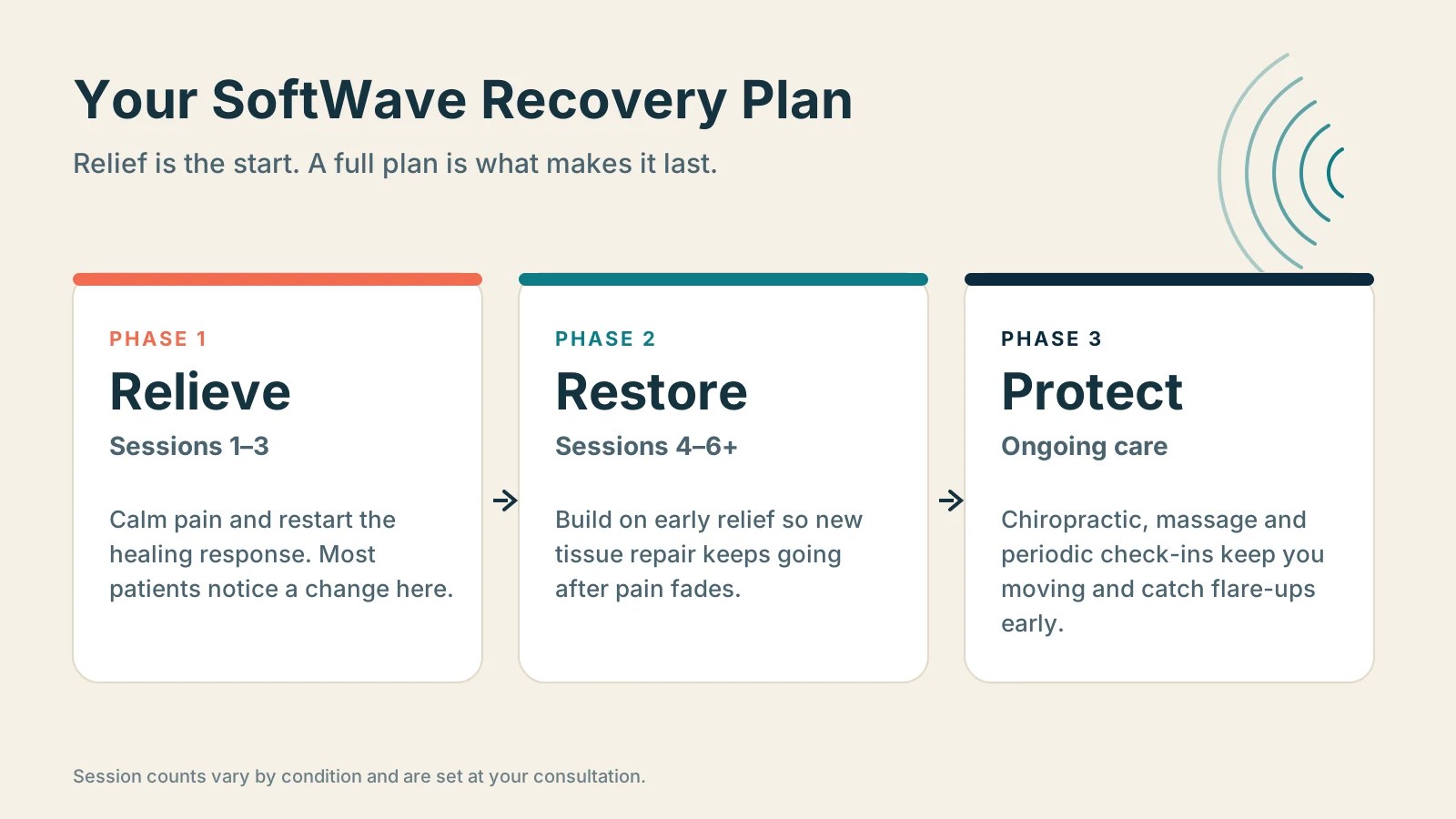
1. Relieve
We start with a thorough assessment to find where the pain is really coming from. Your first SoftWave sessions focus on calming the injured area, while adjustments ease the mechanical stress around it.
2. Restore
As pain settles, we keep going. Continued SoftWave sessions support tissue repair, and chiropractic care corrects the movement patterns that overloaded the area. We check your progress every visit and adjust the plan as you improve.
3. Protect
Once you’re feeling good, regular chiropractic visits and massage help keep your body moving well, and periodic SoftWave check-ins can catch a flare-up before it becomes another long setback. This is how short-term relief becomes long-term health.
Get a full plan built around you
- One assessment covering your joints, posture and injured tissue
- Chiropractic, SoftWave and massage working together, under one roof
- A clear session schedule and progress checks at every visit
- HSA/FSA funds and financing options are often available for SoftWave
Meet Dr. Stacey Gillis

Dr. Stacey Gillis, DC earned her biology degree at UC Santa Barbara and graduated from Life Chiropractic College West in 2001. For more than two decades she has cared for Costa Mesa patients from infants to seniors, and she now leads SoftWave Therapy Orange County from the same Orange Avenue office. More about Dr. Gillis.
Frequently asked questions
Can I get SoftWave and a chiropractic adjustment at the same visit?
Often, yes. Many patients pair the two in a single appointment. Dr. Gillis will decide what’s appropriate for your condition and schedule your plan to fit your week.
Do I need to be a current patient to get SoftWave?
No. New patients can book a free SoftWave consultation through SoftWave Therapy Orange County. Current Harbor Family Chiropractic patients can simply ask at their next visit.
Is SoftWave covered by insurance?
SoftWave is typically not covered by insurance, but HSA and FSA funds can often be used, and financing options are often available. Our front desk can walk you through costs before you start.
How many SoftWave sessions will I need?
Most conditions respond in 3 to 6 sessions. Long-standing or nerve-related conditions may need more. You’ll get a recommended plan after your assessment.
Does SoftWave hurt?
Most people feel a deep tapping or pulsing sensation rather than pain. There’s no anesthesia, no needles and no downtime.
New to Harbor Family Chiropractic?
Book a free SoftWave consultation and find out whether chiropractic + SoftWave is right for you. We’re at 1831 Orange Avenue, Suite B in Costa Mesa, open Monday to Friday, 9am to 6pm.
This article is for general education and isn’t a substitute for a personal medical evaluation. Results vary from person to person, and SoftWave isn’t appropriate for every condition.


